Top Signs You Need Garage Door Service – Don’t Ignore These
Most garage door failures send warning signals for weeks before they break. A door that’s slower, noisier, or slightly crooked is telling you something specific is wearing out, and each symptom points to a predictable failure on a fairly predictable timeline. Ignore them and you’re usually looking at a snapped spring, a dead opener, or a car trapped inside at the worst possible moment. If you’d rather not play mechanic in your driveway, call (888) 991-5420 and we’ll take a look.
Key Takeaways
- Slow, strained opening is often a spring losing tension, not the door “getting old.”
- Jerky or uneven travel usually means worn rollers or a bent track.
- The manual balance test takes 30 seconds and tells you whether your springs are still doing their job.
- Grinding and popping are different sounds with very different meanings.
- A door that works by hand but fails on the opener is an opener problem, not a door problem.
1. The Door Opens Slower Than It Used To
This is the sign people rationalize most. A garage door that takes two seconds longer to open than it did six months ago isn’t aging gracefully. It’s usually a torsion spring that has lost tension, which forces the opener motor to carry weight the spring should be handling. That extra load wears the opener’s gears and motor over time, and the spring itself is heading toward a snap. In our experience, a tired spring that’s already showing this strain tends to fail within a few months, often when the door is halfway up or down.
Springs are dangerous, and this is not a DIY job. A torsion spring under load holds serious stored energy, and the tools and technique required to release it safely are not things you improvise. If your door is dragging, the right move is a proper inspection rather than turning up the opener’s force setting, which only masks the problem and pushes more strain onto the motor. If the grinding or dragging is severe or the door has stopped moving entirely, that’s the point to look at garage door repair before something lets go for good.
2. Jerky, Uneven, or Crooked Movement
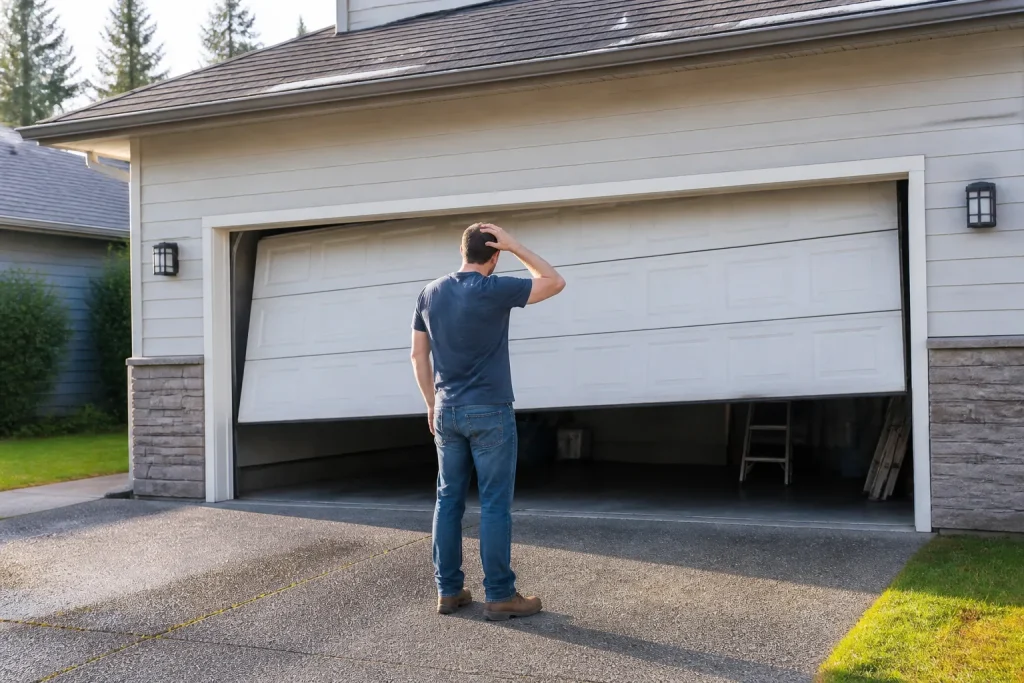
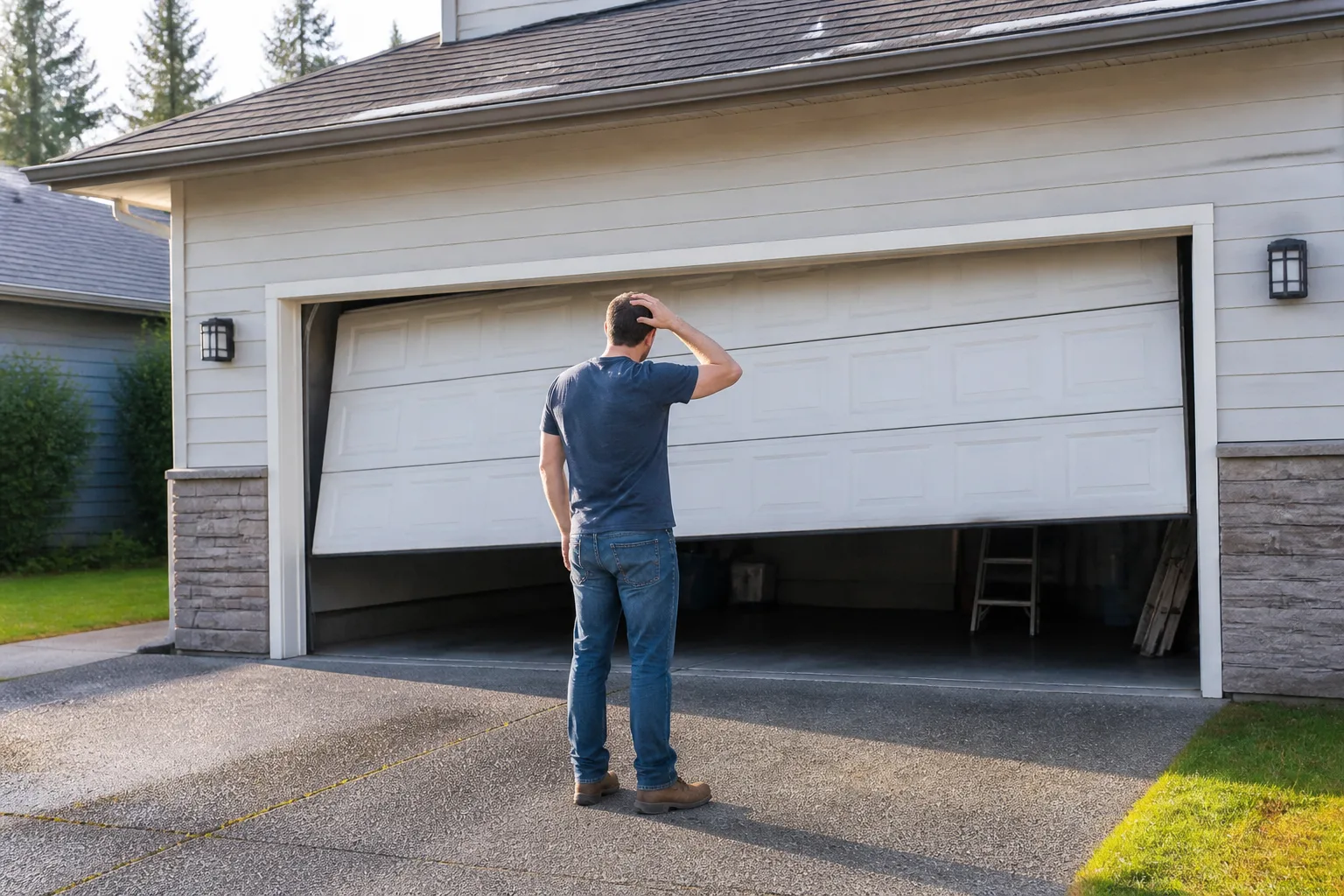
A door that shudders, hesitates, or travels at an angle is almost always dealing with a roller or track problem. The usual suspects are worn galvanized steel rollers, a track that’s been knocked slightly out of alignment, or debris packed into the track channel. When the rollers bind, the door doesn’t move smoothly, and the opener has to fight the resistance. Left alone, a stuck roller can jump the track entirely, which turns a quick roller replacement into a door that won’t close at all.
In Lake City, seasonal moisture is a real factor here. Homes in the Pacific Northwest deal with damp stretches through much of the year, and that moisture accelerates corrosion on galvanized steel rollers and track hardware. A roller that would last years in a dry climate can start to seize up faster when it’s constantly exposed to humidity. That’s why regular lubrication of rollers, hinges, and the track matters more here than it might elsewhere, and why a jerky door in Lake City is worth checking sooner rather than later. A quick visual inspection of the rollers for rust or flat spots often tells you what you need to know; if the track itself is bent, that’s a job for a specialist.
3. The Manual Balance Test: A 30-Second Spring Check
You can find out whether your springs are still properly tensioned without any tools, and it takes about half a minute. The test works like this: disconnect the opener using the manual release cord (pull it when the door is closed), then lift the door by hand to about waist height and let go. A properly balanced door should stay put, roughly where you left it. If it drops on its own, the springs have lost tension. If it rises on its own, they’re over-tensioned. Either result means the springs aren’t doing their job correctly.
What you do with that information matters. A failed balance test confirms the springs are the source of your problem, but it does not mean you should adjust or replace them yourself. Torsion and extension springs are the single most dangerous component on a garage door, and the injuries that come from mishandling them are serious. Use the test as a diagnostic, then bring in a specialist. Spring work is a core part of what we do, not something we hand off, and it’s the piece of garage door service where the safety stakes are highest. If your test shows a problem, stop using the door and get it checked.
4. The Sounds That Matter: Hum, Grind, or Pop
Garage doors make noise, and not all of it is a problem. The trick is telling the three sounds apart. A steady operational hum from the opener is normal. A grinding noise is concerning: it usually points to dry or worn rollers, a failing bearing, or debris in the track, and it tends to get worse the longer it’s ignored. The sound that should make you stop using the door immediately is a sharp pop or snap, especially followed by a sudden bang. That’s often a cable letting go or a spring failing, and a door with a snapped cable can drop without warning.
If you hear a pop, don’t run the opener to “see if it’s okay.” A door hanging on one cable or a broken spring is unstable, and the safe move is to leave it closed and call for help. Grinding you can usually schedule around before it becomes an emergency. The pop is the line between a repair and a hazard. Knowing which sound you’re hearing is half the battle, and it’s the difference between a routine fix and a stranded car.
5. It Works by Hand but Struggles on the Opener
Here’s a distinction that changes the whole repair: if your door moves smoothly when you lift it by hand but strains, stalls, or reverses when the opener runs it, you likely have an opener problem, not a door problem. The door itself is fine. The motor, the drive system, the force settings, or the logic board is where the fault sits. That matters because the fix is completely different. Replacing rollers won’t help a failing opener, and replacing an opener won’t fix a binding door.
Openers from brands like LiftMaster, Chamberlain, and Genie each have their own quirks, force-calibration procedures, and safety-reverse behavior, and diagnosing one is a separate skill from working on the door. We handle both sides of that equation, which means you don’t have to guess which system is at fault before you call. If the door passes the manual balance test and moves freely but the opener won’t cooperate, garage door opener repair is the right starting point. And if the opener is simply at the end of its life, we can talk through a replacement, or a full garage door installation if the door and hardware are aging together.
6. Visible Wear: Sagging Panels, Loose Hinges, and Frayed Cables
Some signs are things you can see rather than hear or feel. Sagging or dented panels, hinges that have worked loose, and cables with frayed strands are all red flags. A frayed cable is particularly serious because it’s a step away from snapping, and a snapped cable can whip with enough force to cause injury. Loose hinges rattle and put extra stress on the panels around them. Dented or sagging panels can also throw off the door’s balance and let moisture into the door’s structure.
Walk around your door once a month and look at the cables, hinges, and panel edges. It takes a minute and catches the kind of wear that’s easy to miss until it fails. When you spot fraying or a panel that’s clearly out of shape, that’s a call-a-specialist moment, not a tighten-it-yourself moment. Our technicians have up to 11 years of experience reading exactly this kind of wear, and we know which brands and components are likely to be involved before we arrive.
7. The Door Reverses or Won’t Stay Closed
A door that reverses partway down, or one that won’t stay shut, is a safety issue. The most common causes are misaligned safety sensors, a track obstruction, or a limit setting that’s drifted out of adjustment. Safety sensors are the small eyes near the floor, and if they’re knocked out of line, dirty, or blocked, the door won’t close. That’s often a quick fix. But a door that closes and then creeps back open on its own can point to a force setting that’s too sensitive, which sometimes masks a deeper balance or spring problem underneath.
Don’t disable your safety sensors or crank up the force setting to force the door closed. Those sensors exist to stop the door on a person, pet, or object, and bypassing them is how injuries happen. If your door reverses without an obvious obstruction, or won’t seal against the floor, get it checked. A door that won’t close properly is also a security gap, and in Lake City that matters when the weather turns and you want the house sealed up tight.
When to Call a Pro
Some of these signs you can watch for a while. Others need a call the same day. As a rule: a pop, a snapped cable, a door hanging crooked, or a door that won’t close safely means stop using it and get help now. Grinding, jerky movement, and a slow door are worth scheduling before they turn into one of the emergencies above. Springs and cables are the parts you should never touch yourself. If you’re in Lake City and want a straight answer about what’s going on with your door, we can look at it and tell you what needs fixing and what can wait.
Related services in Lake City: we handle garage door repair, opener repair, spring repair, and full installation, plus our Lake City Garage Door Repair team covers parts for LiftMaster, Chamberlain, Genie, Clopay, Amarr, Wayne Dalton, Craftsman, and Raynor equipment. Whatever brand is on your door, we know it. One call covers the whole door.
The Bottom Line
A slow door, a jerky track, a grinding roller, or a pop you can’t quite place are all messages from your door’s hardware. They predict failures, and most of those failures are avoidable if you act on the warning. Watch the balance test, listen for the three key sounds, and don’t ignore visible cable or panel wear. Springs are dangerous, so leave those to a specialist. Garage door specialists, not generalists, is the standard worth holding to. If you’re in Lake City and need help, Lake City Garage Door Repair offers free estimates. We quote and agree the price before any work starts, so there are no surprises on the invoice. Call (888) 991-5420.
Frequently Asked Questions
Run the manual balance test: release the opener, lift the door to waist height, and let go. If the door drops or rises on its own instead of staying put, the springs have lost proper tension. A slow, strained door is another strong sign. Call (888) 991-5420 for an exact quote on spring repair; estimates are free.
No, and we’d strongly advise against it. Torsion and extension springs are under high tension, and mishandling them causes serious injuries. Spring repair is a job for a trained specialist. If your balance test fails or you hear a pop, stop using the door and call (888) 991-5420.
Grinding usually points to dry or worn rollers, a failing bearing, or track debris and is worth scheduling. A pop or snap is more urgent and often means a spring or cable has failed; a door in that state can drop without warning, so leave it closed and call for help right away at (888) 991-5420.
If the door moves smoothly by hand but the opener strains, the opener is likely the problem, not the door. That means opener repair or replacement rather than door parts. We diagnose both systems together, so call (888) 991-5420 and we’ll figure out which side of the equation needs the fix.
It depends on the part and the failure. Minor adjustments are on the lower end, spring and opener work sit higher, and the written estimate sets the final price before any work begins. Call (888) 991-5420 for a free estimate and an exact quote.
Written by the team at Lake City Garage Door Repair.
Need Garage Door Help?
Call Lake City Garage Door Repair - the local pro we connect you with is licensed and insured, here with fast after-hours help in Lake City.
(888) 991-5420