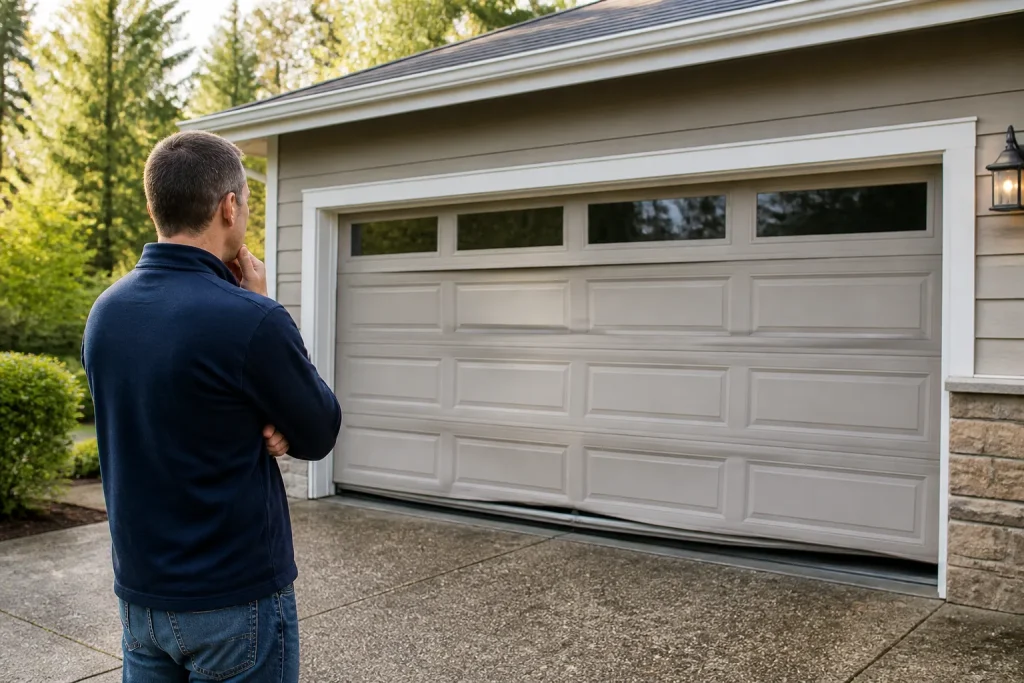
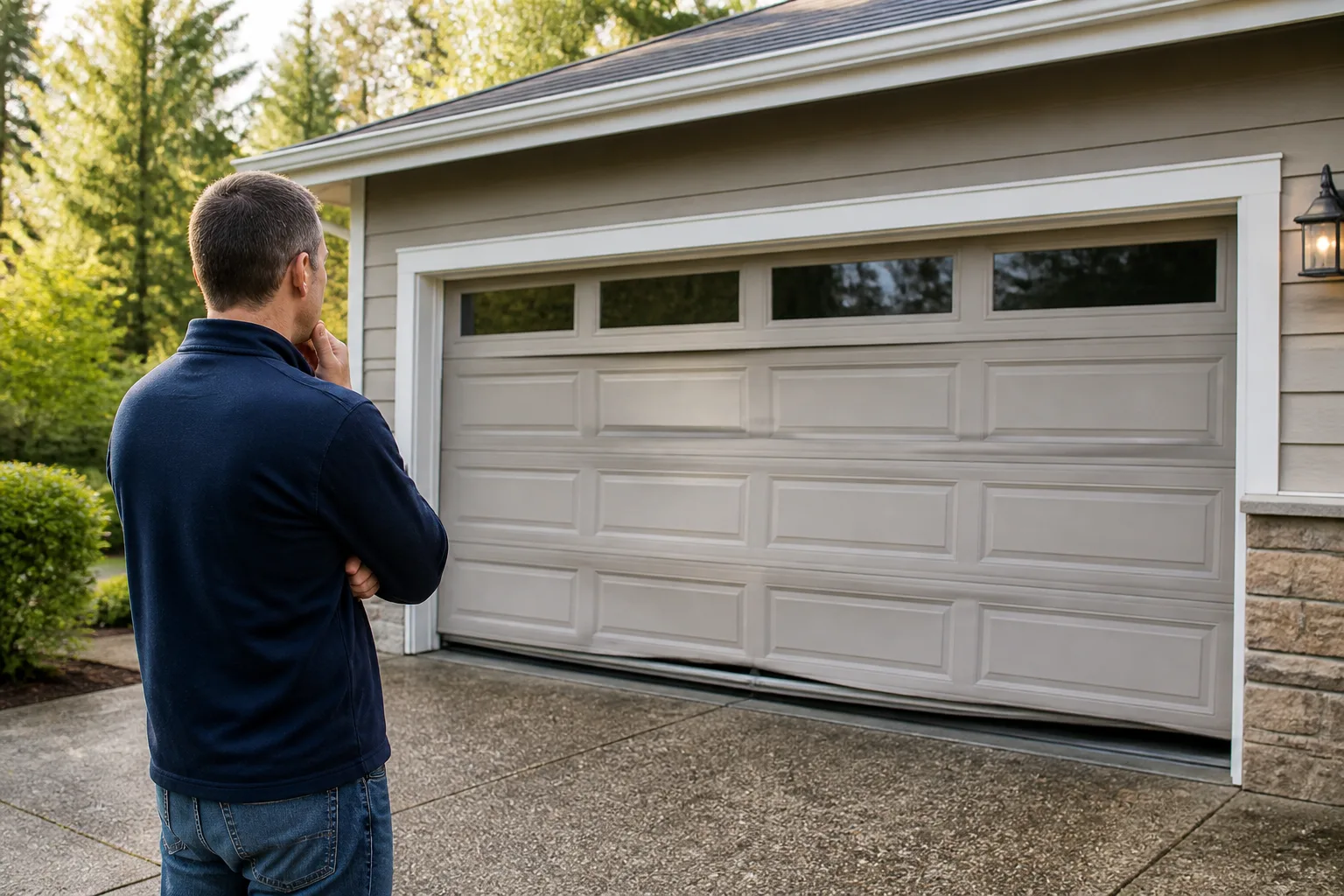
Garage Door Repair: Repair or Replace? How Lake City Homeowners Decide
Most Lake City homeowners end up in the same spot: the door still opens, but something’s off, and you have no idea whether this is a $200 fix or a $2,000 bill. The truth is that nobody decides repair-or-replace from a single rule of thumb. It’s a judgment call built on four things you can actually measure.
So here’s the short version, then we’ll unpack it. In our experience, if the door’s panels and frame are sound, you repair the mechanical parts every time – springs, cables, rollers, openers – no matter what year the door was installed. Replace only when the door’s structure itself is giving out: cracked sections, warped panels, rot, or a bent frame. If you’d rather not work it out alone, call us at (888) 991-5420 and we’ll walk you through it.
Key Takeaways
- Age is the wrong anchor. Failure type and structural condition matter more than how old the door is.
- Mechanical failures = repair. Springs, cables, rollers and openers break on doors that are otherwise perfectly good.
- Structural failures = replace. Warped panels, cracks, bottom-section rot and frame damage compromise the whole door.
- Run the math, not the rumor. Repair cost as a share of replacement cost is the honest comparison – but only once you know both numbers.
- Ask one question to find out if a technician is quoting repair because it’s right, or replacement because it pays better.
Why the “50% Rule” Doesn’t Actually Help You Decide
People hear “replace the door if repairs cost more than half of a new one,” nod, and go back to guessing. The problem isn’t the principle – it’s that you probably don’t know what a new door costs in Lake City or what your specific repair would run. Comparing two numbers you haven’t got is how homeowners end up replacing a door that had one broken spring.
Here’s the honest sequence: identify the failure type first, check the structural condition second, price the repair third, and compare to replacement last. The order matters, because two of those steps decide most calls on their own.
The repair-or-replace decision matrix
- Door age: Instructive, not decisive. A 15-year-old steel door with one bad spring is a repair. A 6-year-old door with warped panels is a replacement. Age tells you what to keep an eye on, not whether to replace tomorrow.
- Failure type: Mechanical failures (springs, cables, rollers, openers, hinges) are component problems and get repaired on a sound door. Structural failures (panel damage, rot, frame distortion) are the ones that end a door’s life.
- Repair cost as a share of replacement: Under roughly a third of replacement cost, repair is the clear call. Around half, weigh it carefully against the door’s condition. Approaching three-quarters of replacement cost, you’re usually better off putting that money toward a new door.
- Number of previous repairs: One isolated repair is normal. Three repairs on the same door in a short stretch is a door telling you it’s tired, and it’s worth pricing replacement alongside the next fix.
A little local context: our technicians have up to 11 years of experience, and those judgment calls are what that experience is for. If a repair looks like the smarter move, we say so.
Failures That Almost Always Mean Repair
If the door’s panels and frame are intact, mechanical failures are repairs – full stop. Springs, cables, rollers, hinges and opener problems happen to doors that are otherwise perfectly fine, and a door with good bones deserves to keep them.
- Springs: The most common failure we see, and a repair. Don’t touch them yourself – garage door springs are under dangerous tension and can cause serious injury. This is a trained-technician job.
- Cables: Also tensioned and dangerous. Repaired by a professional, and usually alongside springs.
- Rollers and hinges: The usual suspects behind a loud, jerky door. Genuinely fixable, and paying attention to noisy rollers early heads off bigger trouble.
- Openers: LiftMaster, Chamberlain and Genie units fail for reasons that have nothing to do with the door. That’s a repair.
One pattern worth knowing: what feels like a door problem is often an opener problem, and vice versa. If the door opens manually but not with the remote, the door might be fine and the drive system tired. That’s why we handle both halves under one roof – springs and structure on one side, opener and drive system on the other. If you’re not sure which you’ve got, our garage door opener repair page covers the common opener symptoms in plain terms.
Failures That Almost Always Mean Replacement
Some failures are structural, and they’re the ones where patching buys you time you don’t really get. When the door’s core integrity is compromised, no amount of adjustment makes it behave like a safe, weather-tight door again.
- Multiple warped or cracked panels: One section can sometimes be swapped. Several failing at once is the door refusing to stay together.
- Bottom-section rot on wood doors: The bottom panel takes the most moisture and the most abuse. Once rot sets into that section, the damage usually runs deeper than what you can see.
- Structural frame damage or distortion: A bent track or distorted frame throws off alignment and stresses every component on the door.
- Repeated, escalating repairs: If the same door keeps failing in different places, replacement stops being a luxury.
When the call is replacement, it should be a measured, quoted job – not a guess made from a photo. We’d rather get you a written price than a hurry-up number on the spot. Our garage door installation page explains how that process works from measure to install.
What Can Break or Keep a Door in Lake City’s Climate
Lake City’s moisture is the quiet variable in the repair-or-replace math, because it decides how long a door survives once it’s installed. Wood doors soak up that damp and can rot at the bottom section far sooner than they would in a drier place. That’s worth knowing when you’re deciding what to put back.
Here’s how the common door materials and choices play out in our part of the Pacific Northwest:
- Steel: The mainstream choice, and the one moisture treats with a shrug – provided the finish stays intact. Keep paint and the bottom edge sealed and a steel door holds up well. Once rust gets a foothold, it spreads.
- Fiberglass: Unbothered by moisture. No rot worries, no rust. The trade-off is that fiberglass is a little less forgiving of hard knocks, and it doesn’t insulate as well as a fully insulated door.
- Wood: Beautiful, and the material that demands the most upkeep in our climate. If you go wood, plan to stay on top of the finish and the bottom edge.
- Insulation: This is where Lake City homeowners should pay attention. A well-insulated door pays back faster in the Pacific Northwest than in drier climates, because our cool, damp stretch of the year makes the garage door one of the bigger leaks in the thermal envelope. If you’re replacing anyway, insulated construction is worth pricing.
Brands we’re certified to service include Clopay for doors and LiftMaster, Chamberlain and Genie for openers, so if you’ve got one of those on your house, we know exactly what we’re looking at.
How to Get an Unbiased Repair-vs-Replace Assessment
The uncomfortable truth is that a sales-motivated technician can make either answer sound obvious. Replacement books bigger tickets, so that’s the nudge you’re most likely to feel. And repair framing is easy to push too, on a door that’s genuinely finished. Your job is to get an assessment that’s about the door, not the invoice.
The single best question: “Can you show me exactly which part is failing, and explain why repair won’t work?” A straight answer points to the specific component – spring, cable, panel section, track – and explains the consequence of repairing instead. If the explanation stays vague (“the door’s just old, replacement is the better value”), that’s your signal to get a second look.
A few more signs of an honest assessment:
- They distinguish between mechanical and structural problems. If everything is framed as structural, be skeptical.
- They give you a written, itemized price before any work starts, and don’t move the number once you’ve agreed to it.
- They can talk about the door and the opener as separate systems.
- They’ll say “repair” when repair is the answer. A specialist doesn’t need to sell a full door to take care of you.
Spring repair is a dedicated service for us, not an upsell or something we avoid. Springs are dangerous – this isn’t a DIY job – and getting a spring specialist to look at the door first, rather than a generalist, keeps the repair-or-replace call honest.
When to call a pro
Any time the spring has broken, the door feels heavy or won’t stay up, the cables look slack or frayed, or the door sits crooked in the opening. Those are safety issues, not weekend tinkering. Call us rather than wrestling with a loaded spring.
Related services in Lake City: if the door itself is the problem, our garage door repair service covers the whole range of fixes, and you can see everything we handle at Lake City Garage Door Repair.
The Bottom Line
For Lake City homeowners, the repair-or-replace decision comes down to the door’s structure, not its age. Component failures on a sound door – springs, cables, rollers, openers – are repairs. Visible warping, cracking, rot at the bottom section or frame damage are the signals that the door itself is done. And whatever material you choose, Lake City’s moisture favors steel and fiberglass over wood, and makes insulation a smart addition to any replacement.
If you’re in Lake City and need help, Lake City Garage Door Repair offers free estimates – call (888) 991-5420 today, and we’ll tell you straight whether you’re looking at a repair or a replacement.
Frequently Asked Questions
Repair it if the failure is mechanical and the panels and frame are sound. Replace it if the structure is compromised by warped panels, cracks, bottom-section rot or frame damage. Repair cost as a share of replacement cost is a useful tiebreaker, but failure type and structural condition decide most calls before the money even enters the picture.
It almost never does. A broken spring is a component failure on an otherwise sound door, and the door is repaired, not replaced. The exception is if the door has multiple failing parts or visible structural damage – then a spring repair is the moment to price replacement. Call (888) 991-5420 for a straight assessment.
Some will, so it’s worth guarding against. Ask them to show you exactly which part is failing and explain why repair won’t work. A technician with a real answer will point to a specific component. If the explanation is vague, get a second opinion before agreeing to anything. Every price we give is written out and agreed before work starts, so nothing surprises you after.
Prioritize insulation and moisture resistance. Steel and fiberglass handle our damp climate better than wood, and an insulated door pays back faster in the Pacific Northwest than in drier parts of the country. Choose a brand the installer is certified to service – ours include Clopay – and insist on a measured, written quote before anything is ordered. Call (888) 991-5420 for a free estimate.
Written by the team at Lake City Garage Door Repair.
Need Garage Door Help?
Call Lake City Garage Door Repair - the local pro we connect you with is licensed and insured, here with fast after-hours help in Lake City.
(888) 991-5420